Description
ECP 525 is a high quality coloured conductive 2K epoxy system. In addition to excellent electrical properties it has superb chemical resistance especially to Skydrol.
ECP 525 can be applied to concrete, structural steelwork and can be applied to existing paintwork (trial patch recommended).
ECP 525 finds application in areas such as:
Floor coatings for electronics EPA +ATEX areas. Compliant with BS EN 61340-5-1:2016 + BS EN 60079.
Typical installations include:
- Electrical industry.
- Petrol/ Chemical industries.
- Water treatment plants.
- Food Industry- Machinery and surfaces.
- And many other industrial uses.
ECP 525 exhibits excellent mechanical properties which will withstand abrasion and impact.
The electrical properties of the paint are permanent and independent of humidity; a conductive underlay is not required, for grounding the system but can be of benefit.
Additionally, ECP 525 provides the option of directly grounding racking/shelving used for storing ESSD’S to the floor.
For personnel grounding applications, the product is best used in conjunction with suitable electrostatic dissipative footwear, e.g., ECP 1450 series foot straps.
Technical data:
Maximum VOC content 54.34g/ltr
Solids Approx. 58%
Flash Point 24 °C
Specific Gravity 1.370 g/cm3
Storage 12 months in original sealed containers
Pot life 6 hour @ 20 C.
Touch Dry @ 20℃ approx. 3 hours
Hard dry @20℃ 16-24 hours
Full dry @ 20℃ 3-7 Days
2 pack mixing ratio 4:1 (4 parts epoxy to 1 part hardener)
Thinning ECP 520/ Thinners or ECP 527/Thinners
Colour Range Light Grey. (Other colours available subject to
agreement on shade and minimum quantities)
Surface Resistance =<10 9 Ω / square @ two coats
=<105 Ω / square @ two coats + ECP 515 or ECP 531 undercoat.
No. of coats 2-3
Wet Film Thickness 88-125 micron
Dry Film Thickness 35-50 microns.
PTV or SRV Values: Sprayed: Dry – 65 Wet – 55
Rollered: Dry – 64 Wet – 35
Brushed: Dry – 60 Wet – 36
| PTV | |
| High Slip Potential | 0-24 |
| Moderate Slip Potential | 25-35 |
| Low Slip Potential | 36+ |
Chemical Resistance
Fluid resistance:
Skydrol No effect on coating after 3hrs immersion.
Engine oil (1hr@60°C) No effect on coating.
Gear oil (1hr@25°C) No effect on coating.
Hydraulic oil (1hr@25°C) No effect on coating.
Diesel (1hr@25°C) No effect on coating.
Water (7 days@25°C) No effect on coating.
Amine (24hrs@25°C) No effect on coating.
QUV 250hrs No chalking or loss of gloss. Slight yellowing.
Grounding
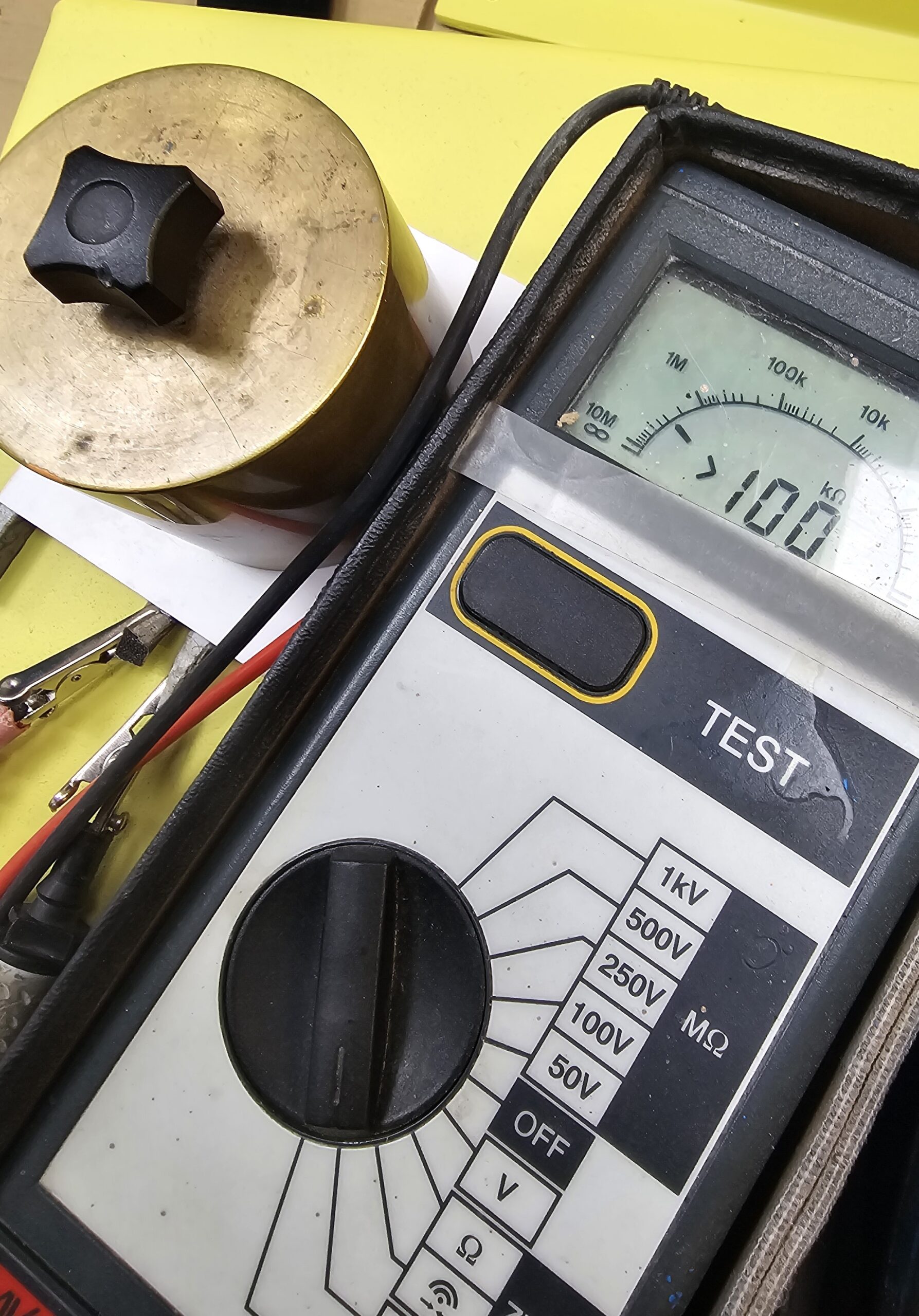
Grounding is best executed by means of a non-oxidising metal plate, bolted to the floor. Contact resistance is significantly reduced if a conductive rubber pad is used in addition to the metal plate top. The grounding plate can then be led to earth via a bonding point and ground cord. ECP 1440/500 Grounding Kit is available as a
standard product for this application.
Grounding can be improved by applying a coat of ECP 515 or ECP 531 as an undercoat although this is not absolutely necessary.
Application
The base paint must be thoroughly mixed to ensure complete dispersion of the conductive medium. Hardener should be thoroughly mixed into the base paint in the ratio 4 parts of base paint to 1 part hardener. Typically, a 4.0 litre pack of paint can be mixed with a 1.0 litre pack of the hardener.
The coating is best applied by means of a spray gun to harness the full potential of electrical and anti-slip properties. The coating can also be applied by brush or roller.
Clean/ degrease surfaces prior to application. It is generally compatible with most existing paints, however, if coating existing paint work we strongly advise painting a small test patch to confirm compatibility and adhesion.
Maintenance
The painted floor should be kept clean to avoid soiling shielding the electrostatic conductive properties of the floor and also its anti-slip performance, therefore a regular cleaning regime should be implemented using non-abrasive and nonaggressive techniques.
Regular checks of the grounding arrangements should also be carried out.
PREPARATION:
NB: As with all paints it is suggested that a small trial be performed before the complete area is coated and when dry tested for adhesion, appearance and resistance.
It is recommended that a sealer such as ECP FloorShield 244+ is used on uncoated concrete floors and similar surfaces before applying ECP 525 or conductive undercoat and that these following preparations are undertaken
NEW CONCRETE: In the case of newly laid concrete, it is important that the concrete has been allowed to dry out for a minimum of 28 days before considering applying a concrete sealer, moisture content should be below 6%.
The main problem with new floors is the weak surface layer (laitence). This water rich top layer forms during the drying out period and is mechanically weak.
The laitence has a chemical composition different to the rest of the concrete. The surface should therefore be acid etched to remove the laitence.
OLD CONCRETE: Remove all oils, grease, dirt etc. together with the removal of old or failed coating to ensure a sound base. In order to ensure good adhesion and long-term performance of the coating, it is essential that the correct type of surface preparation is carried out.
The following are recognised methods: –
ABRASIVE BLAST CLEANING:
Should always be the first choice for heavy duty systems, if conditions allow.
SCARIFYING:(or “scrabbling”)
Rotating wheels and brushes scour the concrete surface.
ACID ETCHING:
This method is most suited for use on new concrete floors and is used to remove laitence, it will not remove old paint, oil or grease. It should only be used where sufficient drainage exists to allow the water and acid solutions to be removed safely.
THIS INFORMATION RELATES ONLY TO THE SPECIFIC MATERIAL DESIGNATED AND MAY NOT BE VALID FOR SUCH MATERIALS USED IN COMBINATION WITH ANY OTHER MATERIALS OR IN ANY OTHER PROCESS. SUCH INFORMATION IS TO THE BEST OF T.B.A ECP.’S KNOWLEDGE
AND BELIEF ACCURATE AND AS RELIABLE AS OF THE DATE INDICATED. HOWEVER, NO REPRESENTATION, WARRANTY OR GUARANTEE IS MADE AS TO ITS ACCURACY, RELIABILITY OR ITS COMPLETENESS, IT IS THE USERS RESPONSIBILITY TO SATISFY THEMSELVES AS TO THE SUITABILITY OF SUCH INFORMATION FOR THEIR OWN PARTICULAR USE.
THE PRODUCT IS UNDER DEVELOPMENT ANDMUST BE DEEMED SUITABLE FOR EACH APPLICATION BY THE USER.